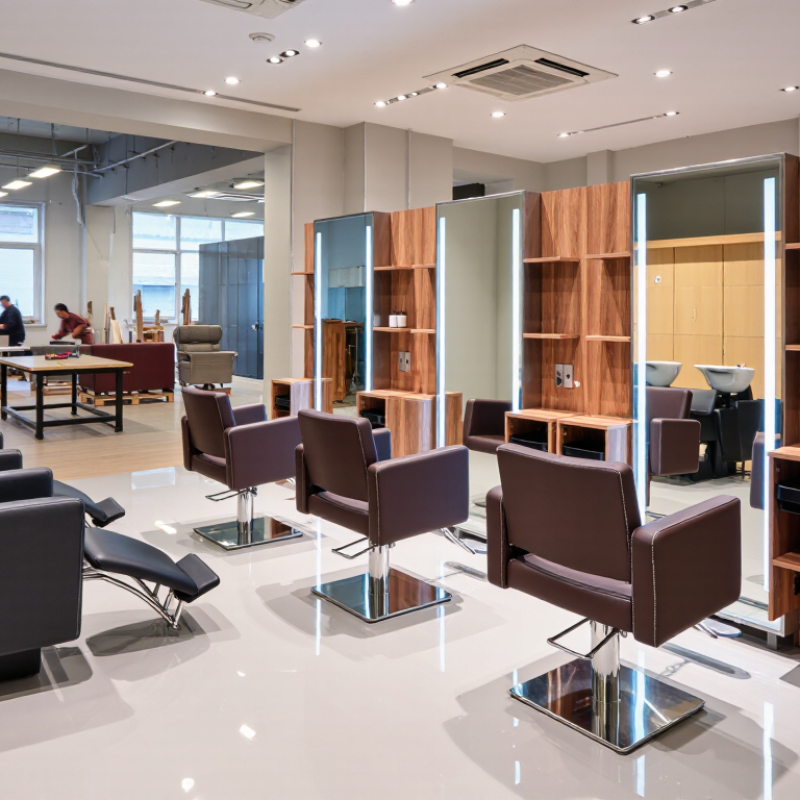
Choosing the right salon furniture factory in China can shape your salon’s comfort, image, and long-term operating costs. A reliable partner should offer more than attractive product photos. It should understand salon workflows, customer movement, installation needs, and daily cleaning demands. A beautiful styling chair means little if its hydraulic pump fails after several months.
Experienced buyers usually examine the factory’s production capacity, material sources, quality controls, and export history. Ask whether the factory builds frames in-house or outsources critical parts. Request clear details about stainless steel grades, leather thickness, foam density, plywood quality, and surface finishing. Samples can reveal loose stitching, uneven welding, unstable bases, or unpleasant chemical odors. Small details matter.
The best salon furniture factory should also provide accurate drawings, realistic lead times, protective packaging, and responsive after-sales support. Visit the workshop when possible. Look at cutting tables, welding areas, assembly lines, and finished goods waiting for shipment. Independent inspections and documented certifications can strengthen confidence, but certificates alone are not enough. Actual workmanship must support the paperwork.
Communication deserves careful attention. A supplier may promise customization, then misunderstand a measurement or color code. Confirm every specification in writing, including dimensions, logos, packaging, spare parts, payment terms, and warranty coverage. Even careful buyers can overlook installation space or local maintenance requirements. That mistake can become expensive. A thoughtful evaluation helps turn a factory relationship into a dependable supply partnership, not merely a one-time purchase.
How to Find the Best Salon Furniture Factory in China?
A reliable factory should begin with your salon furniture requirements, not a product catalogue. Define each item by use, user weight, cleaning frequency, dimensions, and expected service life. A styling chair may face daily impacts, chemical splashes, and repeated height adjustments. A waiting chair needs stable joints, comfortable support, and easy-to-clean upholstery.
Use EN 16139 as a reference for non-domestic seating performance, safety, strength, and durability. Select the correct severity level for commercial salon use. ANSI/BIFMA standards can support evaluation of seating structure, stability, load resistance, and durability. However, do not treat either standard as a universal certificate for every salon product. Their scope may not cover hydraulic systems, electrical functions, or specialist equipment. That distinction matters.
Ask Chinese factories for material specifications, laboratory reports, production drawings, and test records. Request a pre-production sample before approving mass production. Inspect welds, screw connections, foam recovery, base stability, and coating consistency. Place a 120-kilogram test load on the sample if your usage requires it. Check whether the factory can trace steel, foam, leather, and packaging batches. In practice, documents can look complete while small design details remain weak. That is uncomfortable, but useful. Ask who performed each test, which edition was used, and whether the sample matches the final design. A factory that welcomes these questions is easier to evaluate. A factory that avoids them deserves more caution.
Practical specification and factory-audit checklist for commercial salon furniture sourcing
| Furniture Area | Requirement Dimension | Recommended Requirement | Verification Data | Relevant Standard Direction | Factory Evidence to Request |
|---|---|---|---|---|---|
| Styling Chair | Static load capacity | Design target of at least 120 kg user load, with a safety margin defined by the test laboratory. | No permanent deformation, structural cracking, or loss of function after load testing. | Use the applicable non-domestic seating strength and durability methods in EN 16139 or the relevant ANSI/BIFMA seating standard. | Test report, load diagram, weld inspection record, and approved production sample. |
| Styling Chair | Repeated-use durability | Specify repeated seat, backrest, armrest, and swivel or reclining-cycle testing for commercial daily use. | Record cycle count, applied force, failure mode, and post-test functional condition. | EN 16139 and applicable ANSI/BIFMA procedures address strength, durability, and safety performance for relevant seating types. | Complete laboratory report rather than a general “quality certificate.” |
| Hydraulic Base | Height adjustment and stability | Define minimum and maximum seat height, adjustment range, base diameter, and tipping-resistance requirement. | Measure height range in millimetres and document stability under front, side, and offset loading. | Apply the relevant seating safety and stability provisions; confirm applicability with the test laboratory because salon chairs may combine seating and lifting mechanisms. | Mechanism specification, stability test results, component traceability, and maintenance instructions. |
| Barber Chair | Reclining mechanism safety | Require controlled movement, positive locking, pinch-point protection, and a clearly defined maximum recline position. | Inspect locking performance before and after durability cycles; verify no exposed sharp edges or accessible crushing gaps. | Use the applicable safety, strength, and durability requirements for non-domestic seating and moving components. | Mechanism drawings, risk assessment, cycle-test video, and final inspection checklist. |
| Shampoo Unit | Water resistance and drainage | Use sealed edges, moisture-resistant substrates, corrosion-resistant fittings, and a drain layout that prevents standing water. | Conduct controlled water exposure and inspect seams, cabinet bottoms, plumbing joints, and concealed panels for swelling or leakage. | EN 16139 and ANSI/BIFMA seating standards do not replace plumbing, electrical, or material-specific requirements; define these separately in the specification. | Water-resistance protocol, plumbing drawing, material technical data sheets, and inspection photos. |
| Styling Station | Worktop strength and anchoring | Specify distributed load, concentrated load at the front edge, wall or floor anchoring, and maximum supported equipment weight. | Measure deflection, inspect fasteners, and confirm stability after loading and repeated door or drawer operation. | For non-seating products, use the applicable ANSI/BIFMA storage or desk-product methods where suitable; obtain written test-method confirmation. | Engineering drawing, load test record, anchoring instructions, and installation hardware list. |
| Mirror and Cabinet | Glass and tip-over safety | Specify safety-backed or safety-rated glass where required, secure retention, rounded exposed edges, and anti-tip anchoring. | Verify glass markings or supplier documents, retention strength, door alignment, and resistance to forward tipping. | Use relevant storage-unit safety requirements and applicable local glass and installation regulations; do not rely on seating standards alone. | Glass specification, anti-tip test record, wall-fixing diagram, and packaging protection plan. |
| Trolley and Storage | Drawer, caster, and shelf durability | Define drawer load, shelf load, caster load, travel distance, braking requirement, and minimum service cycle. | Record opening cycles, shelf deflection, caster rolling performance, brake holding, and hardware loosening. | ANSI/BIFMA storage-unit methods may be relevant; select the exact method according to product construction and intended use. | Component load ratings, cycle-test records, spare-parts list, and pre-shipment inspection results. |
| Upholstery | Abrasion, seam, and cleanability performance | Select commercial-use upholstery and define resistance to shampoo, water, alcohol-based cleaners, oils, and hair-colouring products. | Evaluate colour change, staining, cracking, seam slippage, and coating damage using agreed laboratory methods. | Material performance tests are separate from EN 16139 and ANSI/BIFMA structural tests; specify the exact fabric or synthetic-leather method. | Material test reports, cleaning instructions, colour approval sample, and batch consistency records. |
| All Furniture | Dimensions and ergonomics | Issue a dimension schedule covering seat height, seat width, seat depth, arm height, worktop height, clearance, and service access. | Check production samples against approved drawings with a tolerance schedule, such as ±2 mm for critical assembled dimensions where feasible. | EN 16139 and ANSI/BIFMA methods support safety and performance assessment but do not automatically define the buyer’s preferred salon ergonomics. | Signed technical drawing, golden sample, inspection report, and change-control procedure. |
| All Furniture | Chemical and odour control | Define restricted substances, adhesive requirements, coating system, formaldehyde expectations, and acceptable odour after unpacking. | Review material declarations and conduct buyer-specified emissions or chemical screening when required by the destination market. | These requirements are complementary to EN 16139 and ANSI/BIFMA performance standards and should be addressed through applicable chemical regulations. | Material declarations, coating data sheets, safety data sheets, and batch traceability. |
| Factory Capability | Quality-management controls | Require incoming-material inspection, first-article approval, in-process checks, final inspection, nonconformity control, and retained samples. | Audit inspection frequency, acceptance criteria, calibration status, corrective-action records, and traceability from material to shipment. | Standards define product performance methods; the factory’s quality system must demonstrate repeatable compliance with the approved test specification. | Anonymised quality records, calibration certificates, process flow chart, and production-line audit access. |
| Pre-Shipment Inspection | Acceptance criteria | Set measurable limits for dimensions, appearance, function, packaging, hardware, upholstery, and documentation before production begins. | Use a defined sampling plan and classify defects as critical, major, or minor with agreed acceptance numbers. | Reference EN 16139 or ANSI/BIFMA test results for performance-critical items, while using the buyer’s approved inspection plan for commercial acceptance. | Signed inspection checklist, measurement records, defect photographs, carton drop or transport assessment where applicable. |
| Export and Installation | Packaging and site readiness | Specify carton dimensions, protection for glass and upholstery, moisture protection, assembly sequence, electrical interface, and site-clearance needs. | Verify package strength, part identification, installation instructions, replacement hardware, and final assembled stability. | Packaging, electrical, fire, and installation rules depend on the destination market and are additional to seating performance standards. | Packing specification, assembly manual, carton marking plan, spare-parts policy, and installation sign-off form. |

China’s US$73.4 billion furniture export figure reveals a deep manufacturing network. It also creates noise. Many factories appear capable online, but photos rarely show daily production standards. Use export data as a screening tool, not final proof. Shortlist factories that regularly produce salon chairs, styling stations, shampoo units, or reception counters.
Ask for recent production photos, material specifications, and export documentation. A reliable factory should explain foam density, upholstery options, metal thickness, and electrical components clearly. Request a sample before placing a large order. Check stitching, hydraulic movement, surface finishing, packaging, and assembly instructions. Small defects often become expensive after shipment.
Tips: Compare three to five factories using the same checklist. Confirm factory address, business registration, production capacity, and quality inspection process. Ask whether the quoted price includes packaging and replacement parts. A video call can reveal useful details, such as unfinished units, crowded workspaces, or unclear inventory. However, video evidence is limited. An independent inspection remains more dependable. Do not choose only by the lowest price; that decision may save money today and create service problems later.
When searching for the best salon furniture factory in China, begin with a material audit. Ask for current specifications for stainless steel, plywood, foam, leather, glass, and coatings. Do not accept “premium material” as evidence. Request supplier declarations, thickness records, test reports, and sample approval sheets. Compare the approved sample with the production piece, especially beneath cushions and inside cabinet joints.
A reliable factory should show a documented quality system, not only a clean showroom. Review incoming-material inspections, production checkpoints, final inspection forms, and nonconformity records. Ask how workers handle uneven welding, loose fittings, color variation, or damaged upholstery. The answers should include responsible staff, corrective actions, and deadlines. Look closely at recent records. Old files prove little.
ISO 9001 certification can support credibility, but verify the certificate’s scope, validity, issuing body, and covered production site. The legal company name and factory address should match your purchasing documents. Request audit findings and corrective-action evidence where disclosure is permitted. Some factories hesitate here. That hesitation deserves attention, though it is not automatic proof of poor quality. During a remote or onsite audit, trace one chair from material receipt to packing. Check batch codes, inspection signatures, and carton labels. Take notes with dates and photographs. My own audits have sometimes missed small packaging defects, so I now inspect packed units twice. Availability matters more than polished promises.
Finding the best salon furniture factory in China requires more than comparing catalog prices. Grand View Research valued the global furniture market at approximately USD 516.66 billion in 2022, showing intense competition and wide supplier variation. Request a written quotation with product specifications, packaging, spare parts, and payment terms. A low unit price may hide expensive installation or shipping costs.
MOQ is often the first negotiation point. Ask whether the factory accepts mixed colors or combined models within one order. For a new salon, a smaller trial MOQ can reduce inventory risk, although the price may increase.
Confirm whether the quoted 30–45-day lead time begins after deposit, drawing approval, or material confirmation. It should not begin vaguely.
Timing matters. The World Bank’s 2023 Logistics Performance Index gave China a score of 3.7 out of 5, ranking it 19th globally. Logistics are capable, but delays still occur during production peaks, inspections, or port congestion. Require a production schedule, inspection photos, and carton dimensions. Warranty terms deserve equal attention. Clarify coverage periods, excluded damage, response times, and replacement procedures. A practical warranty should cover structural defects, welding failures, and hardware problems. Fabric stains caused after delivery may not qualify. Ask for written evidence. I would also request a sample first, because online photographs can flatter weak finishes. That extra cost is usually cheaper than correcting a full shipment.
A reliable salon furniture factory should prove performance before discussing large orders. Request a production sample, not only showroom photos. Examine its frame welds, upholstery seams, foam recovery, and surface coating under bright light. Small flaws matter. They often reveal weak process control. Ask the factory to record each test with the sample number, test date, and operator.
Load testing should match real salon use, including sudden sitting and uneven pressure. Place the stated maximum load on the chair and check the base, joints, and reclining mechanism.
Durability testing should repeat lifting, lowering, reclining, and footrest movement many times. Look for loosened screws, noise, deformation, or stitching failure. The test count must be written down. Vague promises are not evidence.
Hydraulic testing deserves careful attention. Check smooth height adjustment, oil leakage, pressure retention, and controlled descent. A chair that drops quickly is unsafe. Test it after repeated cycles, not only when new.
Safety checks should cover tipping resistance, pinch points, locking parts, sharp edges, and cable protection. Ask for applicable test reports and material records, then compare them with the physical sample.
I would approve production only after a factory corrects failed points and repeats the tests. My own mistake was trusting a perfect first sample; later, repeated use exposed a weak pedal connection.
Factories should welcome this scrutiny, although some may see it as unnecessary delay. Reliable cooperation includes clear drawings, signed specifications, traceable revisions, and honest discussion of what still needs improvement.